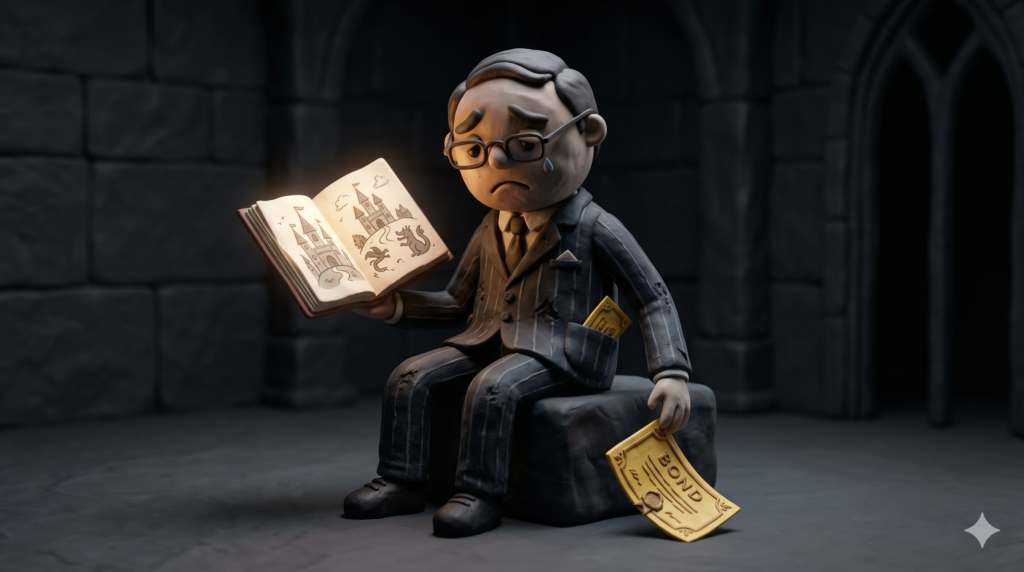
Introduction: The Pride of an Economics Major
Whenever my wife asked me about bonds, I always answered with absolute confidence. After all, I majored in economics and studied finance at university. I firmly believed that I fully understood the relationship between interest rates and bond prices. Compared to my friends who found the bond market confusing, I was quite proud of my knowledge.
Looking back now, my understanding was dangerously superficial. I only knew the textbook theories, but I had never actually tested them with real money in the real market. And that arrogance eventually cost me.
Buying a Story, Not a Bond
Early last year, I decided to restructure my personal pension account, which holds about $70,000. I wanted to move from traditional mutual funds to ETFs. At that time, the U.S. interest rate was unusually high, around 4.24% to 4.5%. It was a desperate effort to absorb the massive money supply created during the COVID-19 pandemic.
I looked at the market and thought, “This cannot last long.”
Driven by this simple thought, on March 26, 2023, I purchased 1,161 shares of a Korean-listed U.S. 30-Year Treasury ETF. Every month, as dividend money came in, I added more cash and bought even more shares.
But here is the painful truth: I was not investing in a bond. I was buying a story.
I bought a narrative that said, “Interest rates will definitely drop soon.” It was a story I created in my own head, and a story I desperately wanted to believe. I used my superficial knowledge to find comfort and justify my actions.
The Illusion of Control
Exactly one year later, on March 25, I looked at my account. I had accumulated 4,899 shares. My total loss was about $1,400. Yes, the monthly dividends would soften the blow a bit, but what did that matter?
While my $25,000 was trapped in a losing bond ETF for a full year, both the U.S. and Korean stock markets were roaring upward. I was sitting there, losing money during a massive bull market.
I was completely anchored to the baseless idea that high rates meant imminent rate cuts. Even worse, I had bought a “currency-hedged” product. So, while the U.S. dollar strengthened against the Korean Won over that year, I missed out on those currency gains—and I actually paid extra fees for the privilege of missing out!
I realized that understanding bond theory is completely different from actually investing in bonds. The bond market does not move simply, and interest rates do not care about my predictions. More importantly, it was not a market where a retail investor with limited capital should try to play timing games.
Conclusion: Giving Up on My Own Story
My pension money is capital I plan to hold for at least another 10 years. I shouldn’t obsess over a one-year return, but leaving my money trapped in a stubborn mistake was the worst possible choice. I had to think about opportunity cost.
Looking back, the biggest loss was not the $1,400. It was the illusion that I was in control. It was the arrogance of thinking, “I can predict this. I will be right.” Nobody forced that illusion on me; I made it all by myself.
So, last month, I sold everything.
I did not sell because I gave up on bonds. I sold because I gave up on my own story. I gave up on the illusion that I could predict the future. From now on, I no longer want to guess what the Federal Reserve will do. I just want peace of mind, letting the market do its work quietly without my ego getting in the way.