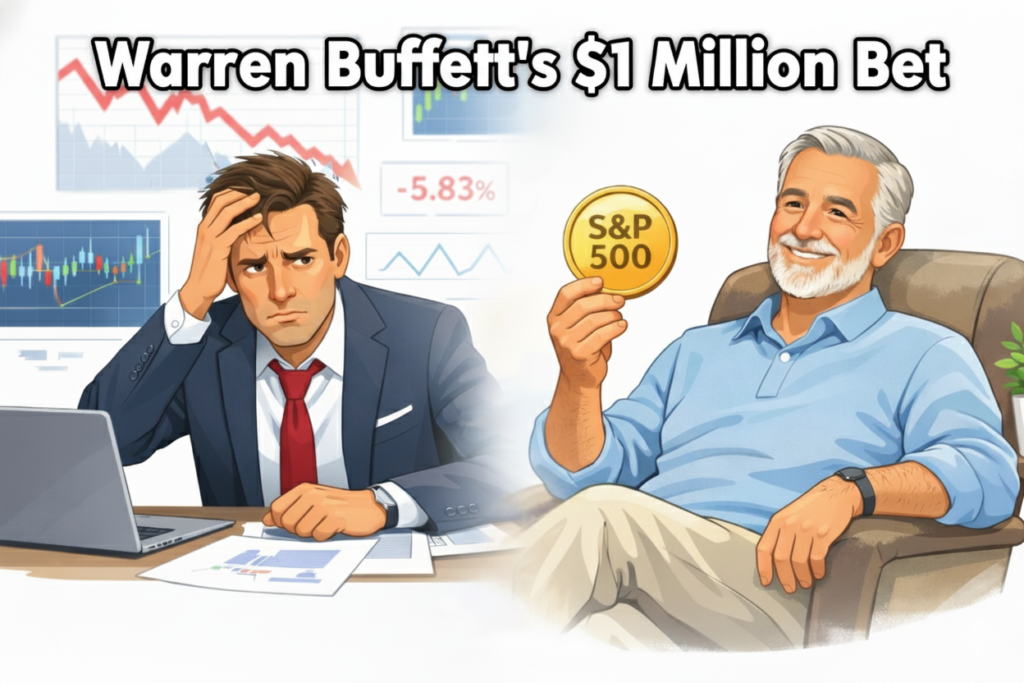
Wondering where to invest your seed money for FIRE? Learn about Warren Buffett’s famous 10-year bet, his 90/10 portfolio rule, and why VOO beats SPY for long-term investing.
Introduction: The $1 Million Bet That Humiliated Wall Street
If you have been following my posts, you know that the first step to FIRE (Financial Independence, Retire Early) is building your initial seed money by investing in dominant growth engines like Nvidia or Apple. 👉 (Note: Missed that post? [Read: The Truth About FIRE: Why Young Investors Must Focus on Growth])
But a massive question remains: Once you have built your wealth, where should you park it so you can actually retire and live off the passive income safely?
Wall Street wants you to believe that investing is incredibly complicated. They want you to hire expensive financial advisors and buy complex mutual funds with massive fees. But the greatest investor of all time, Warren Buffett, vehemently disagrees.
To prove his point, in 2007, Warren Buffett made a famous $1 Million bet with Protégé Partners, a top-tier Wall Street hedge fund.
The rules were simple: Over the next 10 years, Buffett would invest purely in a boring, low-cost S&P 500 Index Fund. Protégé Partners would select a portfolio of elite, highly-paid hedge funds.
Ten years later, the financial world was in shock. The highly-paid hedge fund managers generated a pitiful 2.2% annualized return. Buffett’s simple, boring S&P 500 Index Fund crushed them with a 7.1% annualized return.
Let’s explore why this simple strategy works, and exactly which ETF you should buy for your own FIRE pipeline.
The 90/10 Rule: Buffett’s Will to His Wife
Buffett’s belief in the S&P 500 is not just for winning bets; it is his ultimate advice for his own family.
During the 2013 Berkshire Hathaway annual shareholder meeting, Buffett revealed the instructions he left in his will for the trustee managing his wife’s inheritance. His instructions were shockingly simple: “Put 10% of the cash in short-term government bonds and 90% in a very low-cost S&P 500 index fund.”
Why is the S&P 500 so powerful? The S&P 500 is an index that tracks the 500 largest, most profitable companies in the United States. By buying a single S&P 500 ETF, you instantly own a tiny piece of Apple, Microsoft, Amazon, Nvidia, and Berkshire Hathaway.
Instead of guessing which individual company will survive the next recession, you are betting on the continued growth of the entire American economy. Historically, despite wars, depressions, and market crashes, the S&P 500 has consistently trended upward, averaging roughly a 10% return per year over the long run.

- S&P 500 (Index Fund): It made a total return of 125.8% over 10 years. (This is about 8.5% profit every year.)
- Hedge Funds: The average return of 5 hedge funds was only 36.3%. (This is about 3.0% profit every year.)
- The Lesson: The index fund won by a huge margin! This shows that “low-cost” index investing is often better for a long time than “expensive” active funds.
SPY vs. VOO: Which S&P 500 ETF Should You Buy?
Now that you know what to buy, the next step is knowing which specific ETF to choose. If you open your brokerage app and search for “S&P 500,” you will be bombarded with different options.
The two most famous are SPY (SPDR S&P 500 ETF Trust) and VOO (Vanguard S&P 500 ETF). Since they both track the exact same 500 companies, their performance is virtually identical. However, there is a hidden trap that can cost you thousands of dollars over time: The Expense Ratio (Management Fees).
- SPY (The Pioneer): Launched in 1993, SPY is the oldest and largest S&P 500 ETF. It has massive liquidity, making it the favorite toy for short-term day traders and large institutions. However, it charges an annual expense ratio of 0.09%.
- VOO (The FIRE Investor’s Choice): Created by Vanguard in 2010, VOO was built for the long-term investor. It charges a microscopic expense ratio of just 0.03%.
Buffett constantly warns investors that high fees are the enemy of compounding wealth. If you are a FIRE investor planning to hold your retirement portfolio for 10, 20, or 30 years, paying 3 times more in fees for SPY makes absolutely no mathematical sense.
For the average individual investor looking to build a long-term passive income pipeline, VOO is the clear winner.
👉 But what if you need higher cash flow (dividends) right now? While VOO is the ultimate growth engine, FIRE investors also need strong daily income. Discover the safest cash-machines here: [The Lazy Investor’s Guide to Finding Dividend Kings]
Conclusion: Simplicity is the Ultimate Sophistication
You do not need to be a financial genius, read complex balance sheets, or predict the future to achieve Financial Independence and Early Retirement. As Warren Buffett proved, beating Wall Street is as simple as buying a low-cost S&P 500 ETF like VOO and doing absolutely nothing for decades.
Remember: The stock market is a device for transferring money from the impatient to the patient.