Recently, I got a little bit of spare money. I thought about investing it, but I hesitated because stock prices already seem too high. I don’t think I am the only one feeling this way. Recently, on YouTube and from some experts, I hear a lot of talk about an AI bubble. What goes up must come down. That is a natural rule. But if I put this money into bonds, interest rates are also making me anxious.
Actually, as the new Fed Chair Kevin Warsh era begins, the New York stock market has broken through the 50,000 mark on the Dow Jones, driven by AI. However, if we look coldly behind this big party, sticky inflation at 3.8% is still pressuring the market like a bomb. Expectations for interest rate cuts are fading, and energy costs are rising. It is hard to find a safe direction for my precious spare money these days.
Can We Really Trust Expert Predictions?
At times like this, many economic experts and the media pour out their predictions about the direction of interest rates and the market top. Some warn that a crash is coming right now, while others say we must jump in even now. However, I try not to be shaken by their words, remembering Philip Tetlock’s research mentioned in Daniel Kahneman’s book, Thinking, Fast and Slow.
Tetlock analyzed over 80,000 predictions made over 20 years by 284 “experts” who make a living predicting political and economic trends. The results were shocking. The predictions of these experts were no better than a monkey throwing darts. Even in their own specialized fields, they were not much better than non-experts. The famous and knowledgeable experts were often overly confident, which actually lowered the accuracy of their predictions.
The world is a complex system where countless variables interact randomly. This means it is almost impossible to accurately predict long-term economic trends or the direction of the stock market.
Why I Chose 40% in S&P 500 and 60% in Nasdaq 100
As a normal worker, I cannot perfectly predict when interest rates will drop or when the AI bubble will burst. I cannot do perfect timing trading—selling at the top and buying at the bottom. I am scared because the stock market feels like it is at a peak. But if I stop investing and just hold cash or bonds, there is a risk that my account will be left behind in this era of massive capital movement.
So, I decided to give up making hasty predictions. Instead of acting like a fortune teller trying to guess tomorrow’s stock price, I chose index investing, which owns the entire market. To be exact, I invested 40% of this spare money in the S&P 500 and 60% in the Nasdaq 100 index.
The reason I keep my index investing strategy but put a higher weight of 60% on the Nasdaq 100 is clear. I admit that picking individual stocks is an “illusion of skill,” like throwing dice, even for professional fund managers. But at the same time, I could not deny the fact that this AI fever shaking the world is changing the structure of the world, not just a simple theme.
I wanted to avoid putting all my money into individual big tech stocks and taking on the risk of a single company failing. Instead, I chose a way to ride the market’s growth more aggressively through the technology-focused Nasdaq 100 index, while still enjoying the strong safety net and diversification of broad index investing.
History Shows the Market Always Recovers
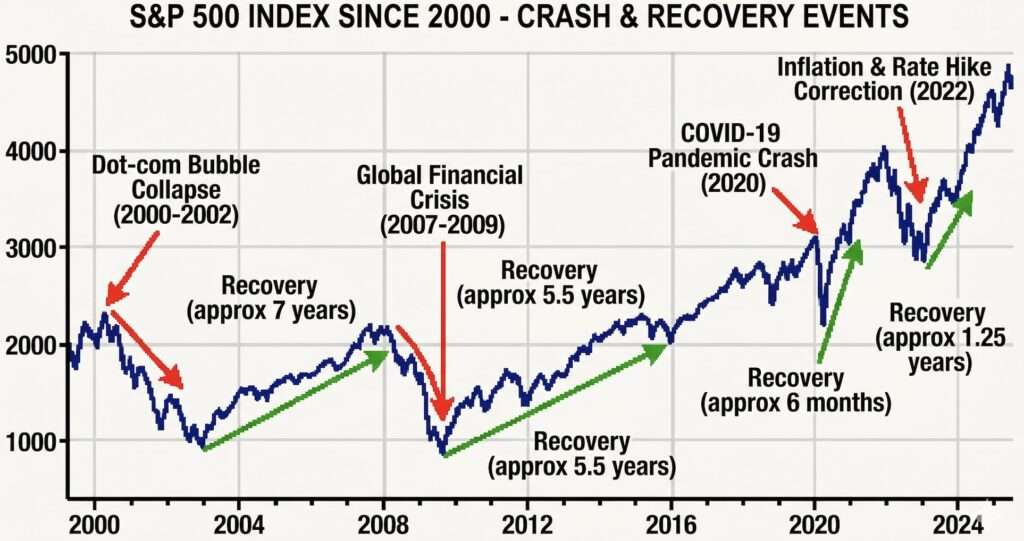
Even if the AI bubble bursts and a market crash comes, I am not too worried. Why? Because historical data proves that the US stock market always recovers eventually. Let’s look at the past major stock market crashes:
| Historic Crash Event (Years) | Max Drawdown | Time to Recover to Peak |
|---|---|---|
| Stagflation (1973~1974) | -48.2% | Approx. 7 years and 6 months |
| Dot-com Bubble (2000~2002) | -49.1% | Approx. 7 years |
| Global Financial Crisis (2007~2009) | -56.8% | Approx. 5 years and 5 months |
| COVID-19 Pandemic (2020) | -33.9% | Approx. 6 months |
| Inflation & Rate Hikes (2022) | -25.4% | Approx. 1 year and 3 months |
As the table shows, a crash can wipe out 30% to 50% of your portfolio, and it might take several years to recover. But the key takeaway is that it always recovers. It is just a matter of time. If you hold individual stocks, they might never go back to their peak. But a broad index like the S&P 500 or Nasdaq 100 will always bounce back as long as capitalism survives.
Nobody knows when the market will go down or what interest rates will be next month. But in front of an unpredictable market, the best thing I can do is entrust my capital to a solid index and silently follow the growth of the era with patience. I believe this is the most realistic weapon for a FIRE investor that will protect my retirement without any fancy tricks.