Introduction
I do not have a special ability to tell exactly which stocks are cheap and which are expensive. Looking at the stock market over the past year, it feels like almost every stock has gone up. In this endless bull market led by flashy tech stocks, the slow stock price of Berkshire Hathaway (BRK.B) is losing people’s attention.
Something similar happened before. During the dot-com bubble in the late 1990s, when everyone was excited about internet companies, Buffett stuck to traditional businesses. People mocked him for being out of touch. Of course, after the bubble burst, Buffett was the final winner.
Will Berkshire’s method work again this time? Honestly, I do not know. The biggest reason is the leadership change, as Warren Buffett has stepped down from the CEO position. It is an unknown path. How should we view the master’s final choice? Today’s post is a record of my calm thoughts as I study to make an investment decision. Let’s think about it together.
Railroads in This Era? And the “Web of Trust”
Berkshire’s portfolio is made of very old-fashioned businesses. While everyone shouts about AI and the cloud, they hold railroads, energy, and insurance.
What is surprising is that even with these traditional businesses, the company showed an 18% increase in operating profit in the first quarter (Read the Q1 2026 earnings report here).
How is this possible? Buffett and Charlie Munger do not micromanage their many subsidiaries. They find honest and capable managers and give them full authority. Munger called this a “seamless web of deserved trust”.
Having worked in large corporations, I sometimes wonder if this is truly possible. In many large Korean companies, the control of the owner is very wide and deep. It is not easy to just trust and leave everything to good managers. Not everyone has the eye to recognize such honest people, and keeping that trust is even harder. In many large companies, professional managers rarely survive for more than five years. This makes me wonder: Can this massive trust system keep working well after Buffett is gone? This is my biggest worry.
Coca-Cola’s Dividends and Buffett’s Irony
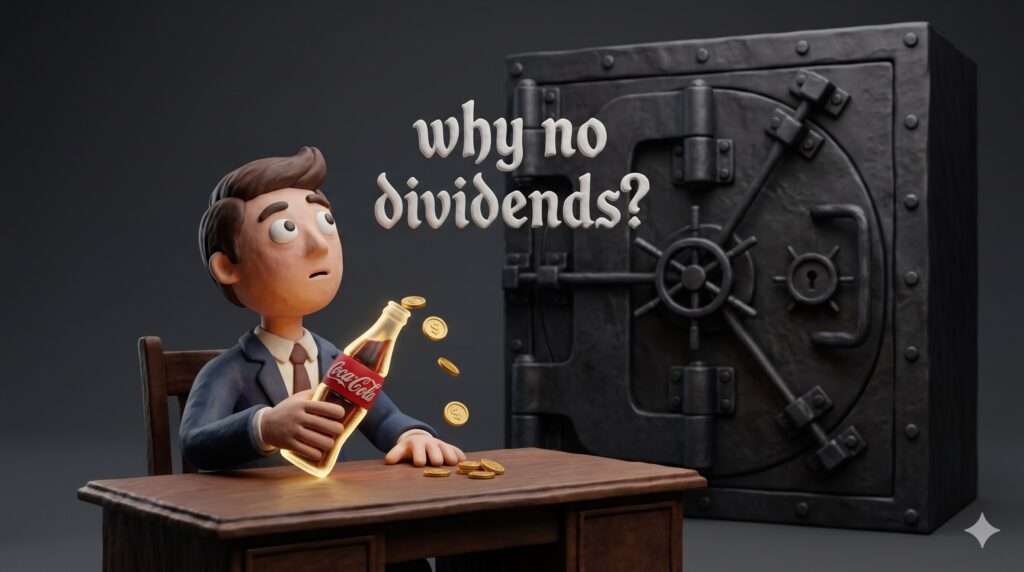
Another contradiction I found while studying Berkshire is about dividends. As many people know, Warren Buffett loves dividends. He receives a massive amount of cash dividends every year from his investment in Coca-Cola, which has already safely covered his original investment amount.
However, Warren Buffett himself does not pay cash dividends to Berkshire Hathaway shareholders. He has kept this strict rule since 1967.
The main reason is taxes. If a company pays a dividend, the money is taxed twice: once as corporate tax, and again as personal dividend tax. Buffett hates seeing shareholders’ money leak away to taxes. Instead, he believes the company should keep the money and invest it perfectly, turning one dollar of cash into more than one dollar of market value.
What amazes me more than this logic is how hard it must have been to keep this rule. It requires incredible effort to convince people to accept this. Buffett kept his principle while most CEOs would have given up to satisfy Wall Street.
Conclusion: On an Unknown Path
In a market where every stock seems to be winning, I still lack the ability to perfectly judge cheap and expensive stocks. I also cannot predict the rough waves Berkshire will face during its leadership change.
However, I keep watching this old-fashioned company. They save money from taxes to reinvest, generate massive cash from traditional industries, and give power to managers only after strict testing. I am considering if this company can be a safe shield for my retirement.
Deciding to invest is a lonely process. How do you view Berkshire’s future? I hope we can think about this together.